From Preparation to Deployment
From California to Singapore, from Paris to São Paulo, the world is building with AI.
Vercel ships v0. Anthropic releases Claude. Google pushes Gemini. Meta open-sources Llama. NVIDIA powers the infrastructure beneath it all. Developers everywhere are experimenting, shipping, iterating. The pace is relentless.
In Haiti, we watched this acceleration. We saw the tools becoming more accessible, the barriers lowering, the possibilities expanding. And we asked a simple question: why should Haitian developers sit on the sidelines?
The answer was obvious. They shouldn't.
So we made a bet: give Haiti's developers proper preparation, decent infrastructure, and real support, then see what they build.
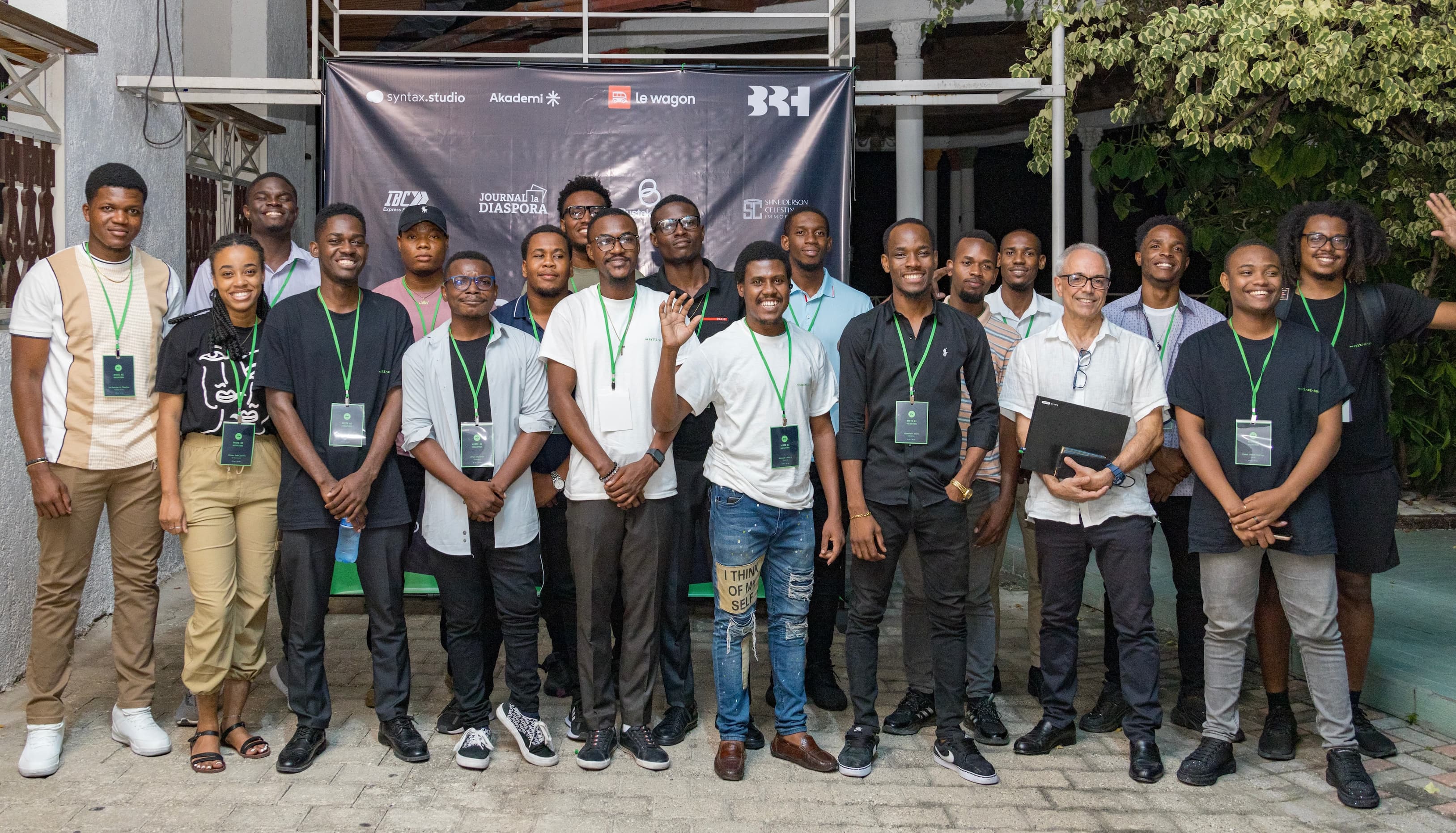
Forty-five people registered. We selected fifteen teams. Eleven showed up and built.
Haiti's first AI hackathon is over. Here's what actually happened.
The Numbers
We knew teams couldn't build serious AI applications in 48 hours if they were also learning basics during that window. So we front-loaded the learning.
Preparation: Four Saturdays of virtual training. Four Wednesday open talks with practitioners from Google, Meta, and Harvard. Continuous support via Discord and WhatsApp for selected teams. One month of intensive preparation.
Execution: 48 hours. November 28-30, 2025. Pétion-Ville.
Outcome: Fifteen teams selected. Eleven delivered working applications. Four didn't show up.
73% delivery rate. For a first-time event in challenging conditions, that's solid.
What They Built
The projects weren't theoretical demos. These are deployed applications you can use right now.
AgriBot (Crusaders) — Agricultural disease detection using embedded AI. Works offline. Delivers diagnosis and treatment recommendations in Creole. Farmers photograph diseased crops, get immediate analysis. Addressing real yield loss in rural areas where agronomic expertise is scarce.
Patrol-X (CoreAI) — Community safety monitoring system. Aggregates data from WhatsApp, X, and local media. AI detects security incidents and natural disasters in real-time. Alerts authorities and affected populations. Built for Haiti's information fragmentation problem.
Braina.ai (Prométhée) — Converts handwritten notes into interactive study tools. Generates quizzes, flashcards, practice exams. Gamifies learning through multiplayer modes like "Mòpyon". Uses OCR and NLP to help students retain what they study.
Beyond the winners: NS4 exam preparation and career guidance (EduPlanAI), 5-minute custom chatbot generation for businesses (NexGen Labs), bank customer churn prediction (BankChurn AI Agent), mental and physical wellness tracking (Octa-AI), native Creole language AI with TTS and STT (Ayira), telemedicine and medical education (OkDòk), personalized learning with career guidance (BriyoAvni), culturally-contextualized educational content (MythosAI).
Eleven teams solved concrete problems. They didn't build pitch decks. They shipped code.
The Pattern
Every successful project followed a similar trajectory.
Week 1-4: Teams that engaged seriously with training. Showed up to sessions. Completed challenges. Asked real questions. Built prototypes.
Friday-Sunday: Teams transformed ideas into working prototypes. Rapid iteration. Debugging. Refining. The preparation paid off, they weren't learning basics, they were executing.
Sunday: Everyone pushed to get projects demo-ready. Live presentations meant real testing. Systems had to work, not just look promising.
The teams that shipped had done the preparation. The teams that struggled hadn't. Simple correlation.
What Worked
The preparation model. A month of training before the event wasn't overhead, it was essential. Teams arrived ready to execute, not ready to learn.
Real mentorship. Practitioners who've built AI systems at scale. People who could answer "we tried that, here's what broke" questions, not just theory.
Proper infrastructure. Internet. Dedicated space. Meals and drinks, everything teams needed to stay focused. Teams focused on building instead of solving logistics.
Realistic scope. We didn't promise to transform Haiti's tech sector in a weekend. We created conditions for developers to prove what they're capable of. They did.
What Was Hard
Attrition. Fifteen teams selected. Eleven showed up. Four couldn't make it to Pétion-Ville, transportation from other regions proved impossible. In Haiti, logistics are never simple. We work with what's real.
Resource constraints. High-end compute wasn't available. Teams built with what they had. Limited resources force creative solutions. That's not a bug, it's the environment we're building in.
Time compression. Forty-eight hours is tight. Teams felt the pressure. Features got cut. Ideas got simplified. Learning to scope ruthlessly under constraints is a skill. Teams are developing it.
Funding realities. Securing sponsorship wasn't straightforward. We faced uncertainty throughout the planning process, worked through funding gaps, and made decisions with incomplete financial visibility. Prize distribution took longer than planned as we finalized commitments. These are the realities of building something new in Haiti's tech ecosystem. We're learning how to navigate funding conversations earlier, set clearer timelines, and operate more efficiently. Next time, we'll move faster.
Building anything in Haiti means navigating from constraint to constraint. The environment is tough. Infrastructure is unpredictable. Resources are scarce and limited.
We had one promise: deliver despite every challenge.
We did.
The Real Value
The prizes matter. Hardware, software licenses, recognition. But the lasting value runs deeper.
Portfolio pieces. Eleven teams now have deployed AI applications. Evidence of competency that matters to employers, collaborators, investors.
Production skills. Participants learned to ship under pressure. Scope ruthlessly. Debug systematically. Present clearly. Skills that compound over time.
Network effects. Participants worked alongside people at similar skill levels facing similar challenges. Those connections last.
Proof of concept. Haiti can produce quality technical events. Haitian developers can master modern AI tools. A community exists worth investing in.
The projects are the evidence. Everything else flows from that.
What Didn't Happen
Let's be direct about what we didn't promise.
We didn't guarantee funding for projects. We didn't promise automatic pathways to market. We didn't claim teams would walk away with finished products ready for scaling.
What we committed to: deliver training, provide infrastructure, create community. Build conditions for serious work. Document what emerges.
We delivered.
What we're committing to now: stay engaged with teams that want to push forward. Talk to partners. Look for opportunities. Make introductions when they make sense.
We can't promise outcomes. But we're committed to helping teams that choose to keep building. Moving forward is a choice. For teams that make it, we're here.
What Happens Next
Three weeks after the event, teams are in different places.
Some are revisiting their projects. Others have moved on. Both are valid choices. We're tracking progress where teams stay engaged, understanding what's working, what's blocking them, where support is needed.
What we're committed to: staying available and proactive. When teams have technical questions, we help. When introductions make sense, we make them. When opportunities align with projects, we connect the dots.
We're realistic about capacity. We're a small organizing team with limited bandwidth. We can't actively manage eleven projects or guarantee partnerships and funding. But we can lead strategically, maintaining connections, identifying opportunities, and staying engaged with teams pushing forward.
The foundation exists: working prototypes, validated skills, established connections. We're here to help teams build from here.
The Ecosystem Question
One event doesn't create an ecosystem. That's not how this works.
What one event can do: demonstrate viability. Prove that quality technical events are possible in Haiti. Show that developers here can compete at high levels when given proper support.
Every person who participated is now part of a network. Every working project is evidence someone else can point to. Every skill acquired compounds over time.
We're focused on the immediate work: supporting teams that want to push forward, creating spaces for continued learning, making introductions when they make sense.
Success might look like participants launching ventures, mentoring others, shipping tools used beyond Haiti's borders. That could happen in months. It could take years. We don't control the timeline, but we're committed to doing our part.
Movements aren't built in weekends. They're initiated in them.
The Partners Who Made This Real
Events like this don't happen spontaneously. They happen because people and institutions choose to invest before seeing results.
Principal partnership: Syntax Studio, Akademi, and Le Wagon Canada. Core infrastructure and training delivery.
Principal sponsorship: Bank of the Republic of Haiti (BRH) and Haiti AI Grant. Made the event financially viable despite funding uncertainties.
Supporting partners: ESIH, TICHaiti, HARTS, ElevenLabs, IBC Express Shipping, Davi's, Shneiderson Celestin Immobilier, Ekosistèm Fintèk Ayiti, Transversal, Journal la Diaspora, Chokarella, and BustekGroup. They committed when the outcome was uncertain.
Individual contributors: Gueter Josmy Faure, Innocent Udeogu, Ben-Manson Toussaint, Jean Sauvenel Beaudry, Dr. Djinaud Prophète, Linh Pham, Patrick Selamy, Dr. Rony Dupuy Charles. Practitioners who volunteered expertise and time when Haiti's first AI hackathon was just an idea.
Individual supporters: Those who contributed via Ko-fi and other channels. Personal investments from people who believe change starts with individuals willing to support their community.
This worked because people decided it was worth supporting. Their investment made it real.
The Next Chapter
We're not immediately planning "Ayiti AI Hackathon 2026." That's not the next step.
We're building an agenda for Ayiti AI. There are other projects we're exploring, initiatives that could push boundaries in different ways. But we're moving deliberately. One step at a time. We don't want to scatter across multiple directions. We want to be intentional.
What we're looking for: the right partnerships. Actors willing to explore unknown paths. People who see potential where others see risk. Partners whose vision aligns with building something meaningful in Haiti's AI space.
We don't know exactly where this leads. That's part of the point. We're staying creative about our approach. Testing ideas. Learning what works. Moving when opportunities align.
For now: documenting what we learned from the hackathon. Staying connected with teams. Exploring what comes next with partners who want to take this further.
We're building slowly. Deliberately. For the long term.
What This Proved
Haiti can produce high-quality technical events when properly supported.
Haitian developers can master cutting-edge AI tools when given structured preparation.
A community exists that's serious about building, not just talking.
The projects are the evidence. AgriBot detecting crop diseases offline in Creole. Patrol-X monitoring community safety across multiple channels. Braina.ai transforming handwritten notes into interactive learning tools. Ayira processing native Creole with speech capabilities. EduPlanAI guiding NS4 students toward exam success. NexGen Labs democratizing AI chatbot creation. BankChurn AI Agent predicting customer attrition for financial institutions. Octa-AI tracking mental and physical wellness. OkDòk expanding healthcare access through telemedicine. BriyoAvni personalizing education with career guidance. MythosAI contextualizing learning for Haitian culture.
Eleven working applications solving real problems.
That's what a successful bet looks like. Not overclaimed success. Not empty promises. Developers who showed up, prepared seriously, and built solutions that work.
The bet was simple: given the right conditions, Haiti's developers would deliver.
They did.
View all projects: https://www.ayiti.ai/en/projects
Follow the journey:
